Decision
Website Design for Steel & TMT Manufacturers
Plact Research
12 min read · Updated Jul 3, 2026 · Benchmarked from real competitor analysis

Key Takeaway
To drive a quick purchasing decision, your site must replace generic brochures with detailed grade pages, localized market data, and a multi-step RFQ funnel.
Procurement teams evaluating steel and TMT suppliers need specific product specs, process pages, and local project data to finalize their decision. This guide explains the exact page taxonomy required to win RFQs and get cited by AI search engines.
See how your site scores against this benchmark
Free audit →Win RFQs and AI Procurement Citations
Competitor benchmark
What the 6 leading steel / TMT sites include
We analyzed 6 leading steel / TMT websites (63 pages), captured June 2026. Presence across the set — honest counts, not percentages:
Presence is what leaders do, not necessarily what you should copy — some widespread patterns (carousels) underperform despite being common.
- Product or service cards6/6
- Image carousel / slider6/6
- WhatsApp chat link5/6
- Contact / lead form4/6
- Email contact4/6
- Comparison / spec tables3/6
- Click-to-call phone number3/6
- RFQ / quote request form2/6
- Statistics / metrics block2/6
- FAQ schema (rich-result eligible)1/6
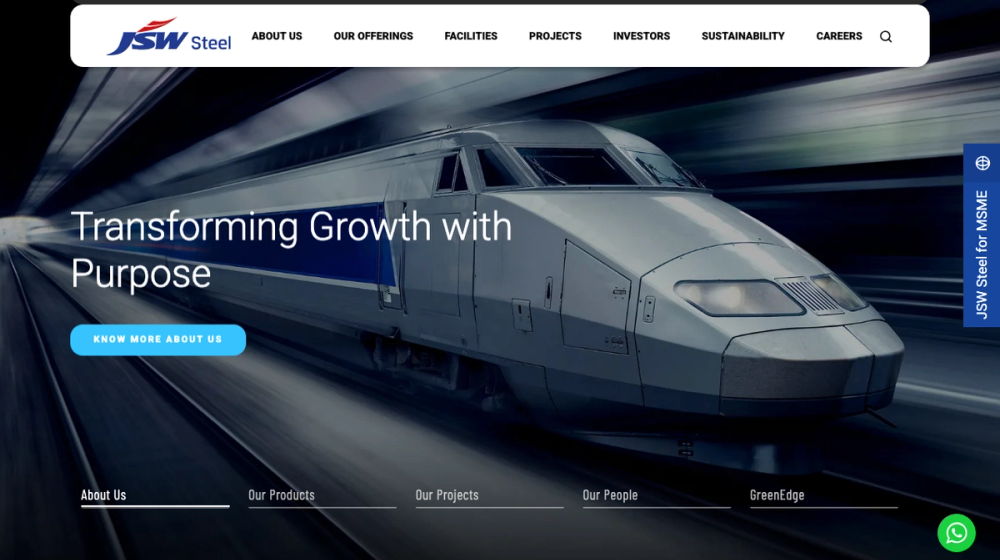
If you run a steel or TMT manufacturer in India or the US, your website should do three jobs at once: win RFQs from buyers searching Google, get cited when procurement teams ask ChatGPT or Perplexity who supplies what, and look credible enough that a contractor replies the same day. Most competitor sites we crawled (a competitor benchmark of six established steel and TMT manufacturer sites) miss at least two of those three: only 33% ship a real RFQ or instant-quote funnel, and only 17% ship FAQPage schema. Everyone has a carousel: 100% do. Plact ships the parts competitors skip, on a fixed price, no sales call required.
What a Steel and TMT manufacturer website actually needs
A brochure is not what you need. Procurement teams, EPC contractors, and dealers do not browse. They check four things: do you make what I need, can you prove your product spec, how fast can I get a price, and are you close enough to ship. The page set below answers each one.
Page taxonomy that does the work
- Product pages, one per SKU family. TMT bar grade pages (Fe500, Fe500D, Fe550, Fe550D, Fe600), billet sizes, structural sections, scrap processing. Each page states the standard (IS 1786 in India, ASTM A615 / A706 in the US), yield strength, available diameters, and pack sizes. Generic "Products" pages let buyers bounce. Specs pages let them stay.
- Service and capability pages. Cutting, bending, galvanizing, fabrication, third-party inspection, mill test certificate download. A common pattern on the sites we crawled is to bury all of this under a single "Services" tab. That kills the long tail. Split it.
- Technology and process pages. For TMT: quenching and self-tempering, thermo-mechanical treatment, ductility testing, rib pattern, rib geometry. For structural: CNC cutting, welding procedure, AISC certification, paint system. Buyers read this before they fill out RFQs. It also feeds AI search.
- Materials and capabilities index page. One page that lists grade, standard, diameter range, application, and finish. Linked from every product page. Buyers print it. This page is the cleanest target for
OfferCatalogJSON-LD. - Case studies and project pages. Named client, project location, tonnage, grade supplied, year. Anonymous case studies ("a leading EPC contractor in Texas") do not rank and do not convert.
- City and location pages. One per market you actually serve. NCR, Mumbai, Ahmedabad, and Hyderabad for a North Indian TMT producer. Texas, Louisiana, and Oklahoma for a US structural fabricator. Each page carries a unique intro, local projects, and local NAP (name, address, phone) matched to your Google Business Profile. Most manufacturers we crawled ship one "Contact" page and call it a day.
- RFQ funnel. A multi-step form, not a generic contact form. See the next section.
- About, certifications, and sustainability. Trust pages. Buyers check these before they pick up the phone.
Every one of the page types above is a unit Google can rank for "[grade] TMT bars [city]" or "[service] steel fabricator [state]", and every one is a unit an LLM can pull into a ChatGPT or Perplexity answer. A 12-page site with proper schema will outperform a 60-page brochure on both.
Components that convert visitors into RFQs
A site is a sales tool, not a magazine. Five components move the needle for steel and TMT manufacturers.
- RFQ and instant-quote funnel. The 33% figure from the corpus is generous. Looked at closely, even those "quote" pages mostly ship a generic contact form. A real RFQ funnel lets the buyer pick a product family, grade, diameter, quantity, delivery city, and required certifications. Eight fields, conditional logic, server-side validation. It auto-routes dealer pricing requests to the dealer manager and bulk procurement requests to the sales lead. Plact ships a Salesforce-less version by default: it emails a structured lead to a shared inbox, with a webhook option for HubSpot or Zoho.
- Spec and capability tables. Tables rank well, get pulled into AI answers, and reduce back-and-forth. One table on the site saves five emails per week.
- Certification wall with BIS and ASTM stamps. Logos as files, plus a sentence per logo saying what it certifies. Buyers copy-paste these into their own QA packets. Below is the canonical table every manufacturer in this vertical should ship on the home page or under a single "Certifications" page.
| Market | Standard | Common grade | Yield strength | Typical use |
|---|---|---|---|---|
| India | IS 1786:2008 | Fe500 | 500 MPa | RCC for residential and commercial |
| India | IS 1786:2008 | Fe500D | 500 MPa, ductile | Seismic zones, high-rise |
| India | IS 1786:2008 | Fe550 / Fe550D | 550 MPa | Bridges, industrial structures |
| US | ASTM A615 | Grade 60 | 60,000 psi minimum yield | General concrete reinforcement |
| US | ASTM A615 | Grade 75 / Grade 80 | 75,000 / 80,000 psi minimum yield | Heavy infrastructure |
| US | ASTM A706 | Grade 60 (low-alloy) | 60,000 psi, weldable | Seismic reinforcement |
A cert wall that links each row to the issuing body's page, with a date stamp and your licence or mill number, beats a folder of PDFs every time.
- WhatsApp and phone CTAs, above the fold and on every product page. The 83% who already use WhatsApp do it because buyers in India will WhatsApp a plant before they will email. Two placements: a header icon with phone number on every page, and a button with a pre-filled message on every product page that includes grade, diameter, and city. US sites get the same treatment with click-to-call and SMS, plus a fallback form.
- Location pages, properly structured. Each city page has a unique intro, a local project, a map embed with proper
Placeschema, and a NAP block that matches your Google Business Profile. Doorway pages with swapped city names and no real content will get you demoted.
Get found by humans and AI (SEO plus AEO)
Two traffic sources matter now: engineers typing into Google at 2pm, and procurement managers pasting questions into ChatGPT or Perplexity at 8pm. They look for different things, but the fixes overlap more than you would expect.
Structured data, the five types that cover 90%
Plact ships the following JSON-LD on every manufacturer site:
Organizationwithname,logo,contactPoint,address,sameAs(LinkedIn, IndiaMart, and Crunchbase in India; LinkedIn, BBB, and Thomasnet in the US).Servicefor each capability: TMT bar manufacturing, rebar fabrication, structural steel erection, hot-dip galvanizing, scrap processing.OfferCatalogfor product families. A parentOfferCataloglists childOfferCatalogper grade, thenOfferper SKU withpriceSpecificationif you publish rates. This is also the structure that AI engines pull when a buyer asks "who supplies Fe500D in Pune".BreadcrumbListon every interior page. Helps Google render breadcrumbs and helps LLMs trace where a fact originated.FAQPageon the FAQ page and on grade pages where you list common procurement questions. Across the 6-site competitor crawl mentioned in the hero, only 17% shipped any FAQPage schema. Google restricted FAQ rich-result visuals to government and health sites in August 2023, but the markup still validates and is parsed by ChatGPT and Perplexity to feed their answers. Skipping it means missing the cleanest AEO win in this vertical.
llms.txt, the new fast-following standard
The /llms.txt proposal (Jeremy Howard, llmstxt.org) is a single markdown file served at the site root. The spec requires an H1 with the company name, a blockquote one-paragraph summary, optional detail sections without headings, and H2-headed link lists such as ## Products, ## Capabilities, ## Locations, each holding [Title](url): description lines. Anthropic and Stripe publish one; a growing number of B2B documentation sites do too. For a steel or TMT manufacturer it is cheap work: ten minutes to draft. It gives any LLM a one-shot view of your SKUs, grades, plants, certifications, and contact paths.
E-E-A-T for manufacturers
E-E-A-T (Experience, Expertise, Authoritativeness, Trustworthiness) shows up on a manufacturer site as:
- Authored pages with names. A metallurgy note from your head of quality control, signed and linked to LinkedIn, cites better than anonymous posts.
- First-party data. Tensile test reports, mill test certificate templates, monthly production figures. These attract backlinks from engineering forums and trade press.
- Third-party mentions. Listings on IndiaMart, Thomasnet, BBB, ISA, AISC. Tie them to your
Organizationgraph usingsameAs. - Transparent sourcing. A "last reviewed" date on grade pages, plain-English summaries of IS 1786 and ASTM A615 / A706 differences.
AEO specifics
Perplexity cites 8.2 sources per answer on average and has a roughly 13% overall citation rate for B2B queries, roughly 22 times more achievable than ChatGPT per a 2026 benchmark across B2B brands. Pages updated within the last 30 days receive a 3.2x lift in Perplexity citations. The takeaway: keep grade and spec pages fresh, and publish one short, factual paragraph per grade that an LLM can lift verbatim. Avoid marketing prose.
Common mistakes we keep seeing on steel and TMT manufacturer sites
- Treating the site as a brochure. Pretty imagery, vague claims, no way to ask for a price. Buyers leave.
- "Contact us" instead of an RFQ funnel. One form for everything. Sales wastes hours routing the wrong contact. Buyers fill it and wait.
- No spec tables. Buyers email asking for weight charts and grade tables that should be public.
- No certification wall, or certs sit in an unmapped PDF. Procurement teams have a checklist. Make it easy.
- WhatsApp on the homepage only. Buyers land on a product page, scroll to find the price, and leave because WhatsApp is on the wrong page. Put WhatsApp on every product page.
- No city pages. Texas is not the same proposition for a Houston EPC contractor as Alabama is for a Birmingham dealer. Generic "we serve the US" copy does not rank.
- Ignoring AEO. Publishing zero
FAQPage, noOfferCatalog, nollms.txt. Easy wins left on the table while you obsess over hero fonts. - B2C tone. Manufacturing buyers are not impulse purchasers. The B2C default of "pretty creative" outperforms "useful", the opposite is true here. Skip the cleverness.
- Slow. Industrial buyers are impatient. A page that takes four seconds to load on a Pune mobile network loses the lead.
FAQ
How much does a steel or TMT manufacturer website cost in 2026? A typical small-business marketing site runs USD 5,000 to 15,000. A feature-rich B2B manufacturer site with a multi-step RFQ funnel, full structured data, llms.txt, location pages, and CMS-driven grade pages lands between USD 15,000 and 45,000 for custom development and runs three to four months end-to-end. Plact ships on a fixed price with a single payment milestone per phase, no sales call.
How long does a rebuild take? Six to ten weeks for a mid-sized manufacturer (one plant, 30 to 60 pages, an RFQ funnel, full schema, llms.txt, and five city pages). Add two weeks per additional plant or per 10 city pages. Plact ships in sprints with weekly demos; we never hold delivery for a "content freeze".
Can you keep our existing content and brand? Yes. A rebuild does not erase your brand. Plact migrates PDFs, datasheets, mill test certificates, photos, and existing grade copy. We rewrite only what hurts conversion.
Do we need a plant in every city we list? No. City pages work for stocking dealers, regional sales offices, and primary delivery regions. What matters is that each page is genuinely useful: a local project, a local contact, and a local case study. Doorway pages with swapped city names and no other content are a waste of effort.
Will this actually win RFQs? Plact cannot guarantee a number of leads. We can guarantee that your site ships a structured RFQ form that captures grade, diameter, certification requirement, delivery city, and quantity, routes the lead to the right sales contact in under five minutes, and feeds your CRM without manual data entry. Faster response plus an easier form equals more wins.
We already have WhatsApp on the homepage. What now? Good. Plact will place WhatsApp and click-to-call buttons on every product page, not just the homepage, with pre-filled messages that include grade, diameter, and city. Most sites we audited had WhatsApp on the homepage only. That is the leak.
Will my site show up in ChatGPT or Perplexity? If you ship FAQPage, OfferCatalog, Service, BreadcrumbList, Organization, and an llms.txt, and you keep grade pages fresh, yes, with higher probability than competitors who ship none of those. We cannot quote a citation rate, but the gap above competitors in this vertical is wide.
---
About Plact Plact (plact.work) designs, builds, and ships B2B websites for service companies, with a niche in industrial manufacturing across India and the US. We ship the parts competitors skip: RFQ funnels, structured data, llms.txt, location pages. Fixed price, no sales call.
Next step Send your current URL and two or three target cities to plact.work (no sales call). We reply within one business day with a rebuild plan and a fixed price for your site.
Sources
- SRMB Steel | India's Best TMT Bars & Saria Manufacturer Brand
- TMT Bars - Best Quality TMT Bars Manufacturer in india | ESL ...
- Finest Quality TMT Bars ... - Incredible Industries Ltd.
- LLMs.txt: Making Your Website AI-Ready
- Mastering llms.txt: Advanced Next.js 15 Implementation
- Creating a llms.txt for NextJs
- AEO対策における LLMs.txt と構造化データの重要性と実装方法
- Adding /llms.txt
- FAQPage - Schema.org Type
- Organization Schema JSON-LD -- Examples for Brands and Companies
- FAQ Page Schema Markup JSON-LD Code Generator & ... Classy Schema
Send us your current URL and the cities you target. We reply within one business day with a page-by-page rebuild plan and a fixed price. No sales call required.
Related guides