Decision
Website Design for Advertising Agencies
Plact Research
7 min read · Updated Jul 3, 2026 · Benchmarked from real competitor analysis
Key Takeaway
To drive a favorable decision, your platform must combine rapid performance, distinct service modules, and tailored local communication channels.
Advertising agencies require specific structural elements to convert B2B prospects. Discover how clear service hierarchies, regional engagement paths, and fast load speeds influence a buyer's decision.
See how your site scores against this benchmark
Free audit →What the site needs
An ad agency website requires specific structural elements to convert B2B prospects. First, it needs a clear hierarchy of services. The standard agency taxonomy includes Creative, Media Buying, Digital Marketing, PR, and Analytics. Prospects must find their specific need within two clicks. A flat structure where all services sit on a single page with anchor links fails to provide the depth required by B2B buyers evaluating a high-ticket engagement.
B2B norms dictate different engagement paths based on geography. In India, B2B buyers expect immediate communication. WhatsApp integration is common, appearing on 60 to 100 percent of local B2B sites. Your site needs a floating WhatsApp widget linked to a dedicated sales number. Indian buyers use WhatsApp to share briefs, ask for media kits, and negotiate retainers. If your site lacks this, you lose the lead to a competitor who offers instant chat.
In the US, buyers prefer structured inquiry forms. While RFQ (Request for Quote) usage varies across verticals, agency sites benefit from a "Start a Project" form that captures budget, timeline, and scope. US B2B buyers research extensively before making contact. Your site needs downloadable case studies, white papers, and clear service descriptions to feed this research phase.
Speed is non-negotiable. Agency sites are often image-heavy, featuring high-resolution videos and complex animations. You need aggressive image optimization, modern format delivery (WebP, AVIF), and lazy loading to maintain a sub-2-second load time. Google Core Web Vitals directly impact your search ranking. If your site takes longer to load than a client's campaign, prospects will bounce.
Finally, the site needs a clear positioning statement. "We are a full-service agency" is not a positioning statement. You must specify your focus: "D2C performance marketing for beauty brands" or "B2B tech PR in North America." Specificity converts. Generalization drives prospects to the back button.
Components that convert
The taxonomy of an ad agency site demands specific components to drive conversions. These are not arbitrary design choices. They are structural requirements based on how B2B buyers evaluate service providers.
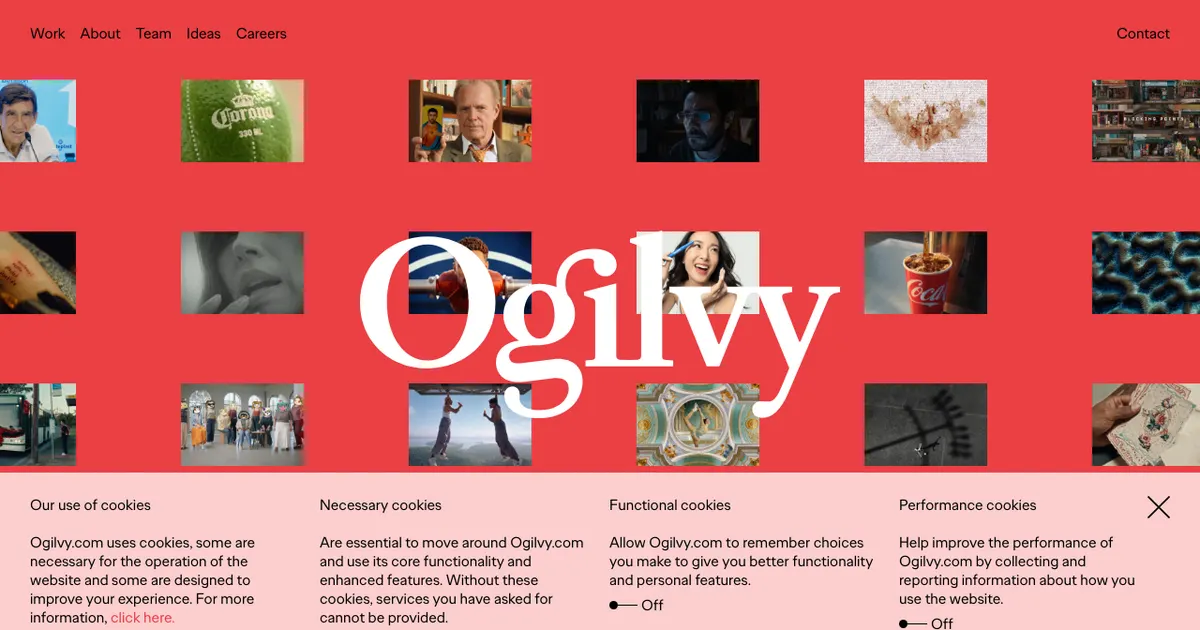
Case Study Carousels: Carousels are ubiquitous on agency sites, appearing on 80 to 100 percent of top-performing B2B agency platforms. A carousel allows you to showcase multiple client successes without overwhelming the user with text. Each slide must feature a high-contrast visual, a one-sentence result (for example, "Increased ROAS by 40% for a D2C skincare brand"), and a link to the full case study. Do not use auto-rotating carousels. They frustrate users and cause accessibility issues. Let the user control the navigation.
Service Modules: Break down your offerings into distinct blocks. A grid layout works best for this. Each block needs a title, a three-bullet description of the deliverables, and a contextual call to action. If a prospect clicks on "Media Buying," they should go to a dedicated landing page detailing your capabilities in programmatic, OTT, and linear TV buying.
Team and Culture Pages: B2B buyers buy from people. Your team page should not be a grid of headshots with generic titles. Include brief bios that highlight specific expertise. "Lead Copywriter with 10 years in SaaS" is better than "Creative Director."
Contact Flows: The contact mechanism must adapt to the user's intent.
| Component | US Agency Norm | India Agency Norm |
|---|---|---|
| Primary Contact | Structured project inquiry form | Floating WhatsApp widget |
| Portfolio Display | Detailed downloadable case studies | Visual carousels with quick links |
| Lead Capture | "Start a Project" multi-step form | Direct chat to share briefs |
| Mobile Expectation | Responsive, fast-loading research hub | Tap-to-call, WhatsApp dominant |
Social Proof: Client logos are insufficient. B2B buyers are immune to grayscale logo grids. Use specific metrics. "Increased ROAS by 32% for Client X" builds more trust than a logo. If you cannot share client names due to NDAs, share the industry, the challenge, and the exact result.
Resource Hubs: A blog or insights section is necessary for SEO, but it must be organized by topic. Categorize your content by service line and industry. A prospect looking for "B2B SaaS marketing strategies" should not have to sift through posts about consumer packaging trends.
SEO+AEO (JSON-LD+llms.txt)
Traffic means nothing if the site is not optimized for search engines and answer engines. The landscape has shifted from traditional SEO to AEO (Answer Engine Optimization).
JSON-LD Implementation: Structured data is critical for Google to understand your agency. Use Organization schema to define your agency, its locations, and contact points. Use Service schema for each offering. This tells search engines exactly what you do and where you do it.
Regarding FAQPage schema: It is rare across all verticals, appearing in less than 25 percent of B2B sites. Do not stuff your site with unnecessary FAQs just to capture schema snippets. Google has deprecated many FAQ rich results. Keep FAQs restricted to genuine buyer questions, typically at the bottom of a service page, and use the schema only when the questions directly address complex service terms.
AEO (Answer Engine Optimization): Large Language Models (LLMs) like ChatGPT and Perplexity now synthesize search results. To get cited by AI, your content must be direct. State facts clearly. "We are a full-service ad agency in Mumbai specializing in D2C brands" is better than "We are a dynamic team of creative thinkers." LLMs prefer declarative sentences. They look for entities and relationships. Your H2 and H3 tags should be questions or clear statements of fact.
llms.txt: Implement an llms.txt file in your root directory. This file provides LLMs with a clean, markdown-formatted version of your agency's core information, services, and pricing models. It guides the AI to understand your exact value proposition without parsing complex HTML or JavaScript. Standard robots.txt blocks crawlers. The llms.txt file invites AI models to read a summarized version of your site. This is a new standard, but early adopters will see higher citation rates in AI-generated search results.
Local SEO: If you serve specific markets, your site needs location-specific pages. "Advertising Agency in Bangalore" or "Creative Agency in Chicago" should have dedicated pages with local schema, client testimonials from that region, and specific local case studies.
Mistakes
Ad agencies make predictable mistakes on their own sites. These errors cost leads and damage credibility.
Vague Copy: Avoid generic statements. "We build brands" tells the prospect nothing. Specify the verticals and the channels. "We build D2C beauty brands through TikTok and Meta advertising" is a clear value proposition.
Unstructured Portfolios: A grid of images without context fails to convert. Every portfolio item needs a title, the challenge, the solution, and the measurable result. If you cannot show the result, do not feature the work.
Ignoring Mobile B2B Users: B2B research happens on mobile. Over 50 percent of B2B queries happen on smartphones. If your desktop site relies on hover effects that do not translate to touch screens, you lose leads. Mobile design must be a distinct process, not an afterthought.
Hiding Pricing: While exact pricing is difficult for custom agency work, hiding all pricing indicators wastes time. Use "Projects starting at $10,000" or "Retainers begin at INR 2,00,000 per month" to filter out unqualified leads. This saves your business development team from having conversations with prospects who cannot afford your services.
Slow Hosting: Shared hosting kills agency sites. Invest in dedicated B2B cloud infrastructure with a CDN. A slow site signals a lack of technical competence.
Overusing JavaScript: Heavy JS frameworks make sites hard to crawl. Search engines prefer server-side rendered HTML. Keep your tech stack simple. A fast, static site with a headless CMS will outperform a complex React app in search rankings.
FAQ
How long does it take to build an agency website with Plact? A standard B2B agency website takes 4 to 6 weeks to build. This includes strategy, design, development, and AEO optimization.
Do you build separate sites for our US and India offices? Yes. We build region-specific landing pages or entirely separate sites based on your operational structure. We implement the correct regional norms, including WhatsApp for India and structured RFQ forms for the US.
Can we migrate our existing case studies to the new site? Yes. We structure your existing case studies into a standardized format that highlights the challenge, solution, and measurable results. We also optimize the media for fast loading.
About Plact
Plact (plact.work) is a B2B website builder focused on structured, high-converting websites for service businesses. We build platforms that align with regional B2B norms and technical SEO standards. We do not build digital brochures. We build lead generation engines.
Send your current website URL and the cities you serve. We will reply with a rebuild plan and a fixed price.
Send us your current URL and the cities you target. We reply within one business day with a page-by-page rebuild plan and a fixed price. No sales call required.
Related guides