SEO, AEO and GEO for B2B suppliers: what to fix first
Find the first broken step between a buyer's search, fit assessment and useful enquiry, then see what Plact manages across the path.
Updated
Suitable buyers may be looking, yet still fail to find the business, understand its fit or know what to send next.
Picture a buyer searching for a custom component supplier. They reach a page that says “precision solutions for every industry,” but it never explains processes, material families, order profile, drawing review or inspection requirements. The page was found. The buying journey still broke.
Treat visibility as one path: be found, be chosen, start a conversation and learn from what happens next. Fix the first step that stops a suitable buyer from moving forward.
The buyer path from discovery to learning
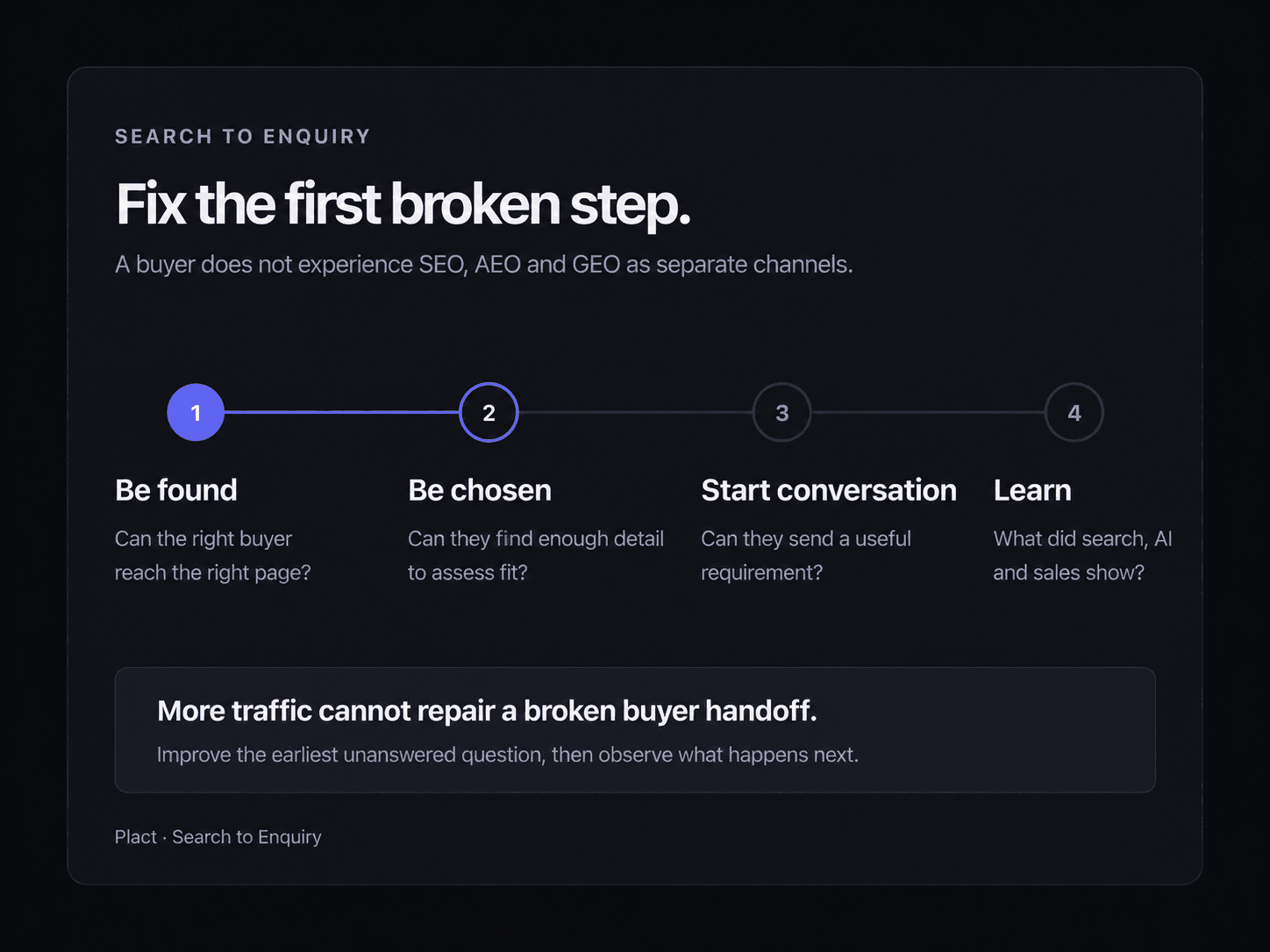
Be found
Can the right buyer reach the right page?
Be chosen
Can they find enough detail to assess fit?
Start conversation
Can they send a useful requirement?
Learn
What did search, AI and sales show?
First ask: where does the buyer get stuck?
Start with one commercially important product, capability or service. Follow the buyer's path and choose the earliest problem that blocks a useful next step.
- The right buyer cannot find the relevant page
First useful moveCheck access, index eligibility, internal links and whether the page matches the real requirement
What can waitAnother broad article
- The buyer finds the page but cannot assess fit
First useful moveAdd the scope, boundaries and details needed to decide
What can waitMore traffic to the same vague page
- Important facts are buried or contradict sales
First useful moveConfirm the current answer and give it one clear public owner
What can waitRepeating the uncertain claim elsewhere
- An AI answer describes the business incorrectly
First useful moveStrengthen the canonical facts and correct legitimate third-party sources where possible
What can waitInventing special AI schema or an llms.txt shortcut
- The buyer understands the business but cannot send a useful requirement
First useful moveRepair the enquiry path and ask only for details needed to respond
What can waitChasing impressions before fixing the handoff
- Useful enquiries arrive but nobody records what happened
First useful moveConnect the source, enquiry quality and sales decision
What can waitAttributing revenue to the loudest dashboard
This order matters. A supplier with a strong catalogue and a broken enquiry route needs different work from a custom manufacturer whose technical scope is missing. See how a qualified enquiry path helps sales receive enough context to respond.
Where SEO, AEO and GEO fit
The labels describe overlapping ways to discover and understand the same business information. They are not a reason to write three versions of a capability page.
- SEO
- Discovery through search engines
- AEO
- Answers that are direct, specific and easy to retrieve
- GEO
- How public information is represented in generated answers
For Google AI Overviews and AI Mode, ordinary search foundations still apply. Google says there is no extra technical requirement or special schema for inclusion. A page must be indexed and eligible to appear with a search snippet, but selection is not guaranteed. Read Google's AI-feature guidance.
ChatGPT has separate publisher controls. OpenAI says OAI-SearchBot access helps make public content available for summaries, citations and links. Access makes discovery possible; it does not guarantee a citation. Read OpenAI's publisher guidance.
The practical job is to make one truthful answer useful to a buyer, a search engine and an AI system. That is the purpose of Search and AI discovery.
Build the answer around a real requirement
Return to the custom component buyer. A useful page would help them answer:
- Which processes and material families are currently supported?
- Which dimensions, tolerances or inspection needs require drawing review?
- Does the business seek prototypes, repeat batches or production work?
- What can be confirmed publicly, and what needs controlled document exchange?
- What should the buyer send for an initial feasibility discussion?
Do not publish a tolerance, capacity or certification because another supplier has one. If feasibility depends on geometry, material or inspection conditions, say so. “Send the drawing for review” is a useful boundary. “We can make anything” is not.
The deciding details change with the business. A distributor may need model families and substitution policy; an exporter may need destination, packaging and document limits; an industrial service may need method, asset scope, service region and site access. A separate page is useful only when those differences change the buyer's decision.
What Plact handles
Search to Enquiry treats the path as one connected job. Plact researches the questions suitable buyers ask, finds the page that should answer them, prepares or publishes the improvement through your website setup, connects the page to a useful enquiry and learns from search, AI and sales feedback.
- You set the priorities and confirm technical and commercial facts.
- Plact identifies the break and coordinates the specialist work.
- Your team chooses what goes live and responds to enquiries.
- Plact recommends the next improvement from available feedback.
Use the same path to see what changed
Keep the steps connected without turning them into one visibility score.
- 01Be foundThe page is accessible and index-eligible, and relevant buyers can reach it through search, AI or direct links.
- 02Be chosenThe business is represented accurately and the buyer can find the details that determine fit.
- 03Start conversationSales can accept, clarify, decline or progress the enquiry without rebuilding the basic requirement.
- 04LearnSource and sales feedback stay connected so the next improvement follows what actually happened.
Search visibility is not enquiry quality, and enquiry quality is not revenue. Preserve those distinctions while keeping enough context to decide what should happen next.
Improve an existing page or create a new one?
Improve the current owner
Use the existing product, capability or service page when the buyer's question already belongs there. Correct the answer where future buyers will expect to find it.
Create a distinct resource
Add a page only when a separate decision needs a useful worksheet, supported comparison, difficult limitation or original evidence that the current owner cannot hold clearly.
Do not manufacture a page for every country, material, industry and AI label. This guide cannot tell you how much demand exists, whether an engine will choose a page or what commercial result a change will produce. Those answers need your business facts and observed outcomes.
If the open question is who should own and carry out the work, compare the available approaches.
Find the first useful improvement.
Share your website and one priority product, capability or service. Plact will trace the buyer path and show where to start.
Primary sources
Provider guidance checked 4 September 2026.
- AI features and your website
Google Search Central · Last updated 10 December 2025
Ordinary search foundations apply to AI Overviews and AI Mode. Eligibility does not guarantee inclusion.
- Publishers and Developers FAQ
OpenAI · Checked 4 September 2026
OAI-SearchBot access can make discovery possible. It does not guarantee a summary, citation or link.
- Creating helpful, reliable, people-first content
Google Search Central · Checked 4 September 2026
Content should serve an intended audience and help the reader achieve a real goal.