Decision
Website Design for Mining & Mineral Processing
Plact Research
12 min read · Updated Jul 4, 2026 · Benchmarked from real competitor analysis
Key Takeaway
The core decision in mining website design is moving beyond a brochure to a working catalog with detailed spec tables and an inquiry loop that buyers can actually use.
This pillar helps the owner making the decision to patch or rebuild a B2B mining equipment site. You will learn the exact page taxonomy required to turn procurement engineers scanning for specifications into actual inquiries.
See how your site scores against this benchmark
Free audit →Delivering Specs Contact And
You sell iron ore spirals, dense media cyclones, jaw crushers or turnkey beneficiation plants. Your buyers are procurement engineers at NMDC-tier operators in India, mine supervisors at aggregate yards in Texas, and OEMs sourcing wear parts in Pune. They do not read your homepage hero copy. They scan for a phone number, a city, a spec sheet, and a way to ask for a quote. If your site does not give them all four in the first ten seconds, you have not lost the lead. They have opened a competitor tab.
This pillar is for the owner of a B2B mining or mineral processing company deciding whether to build, rebuild or patch their current site. It is grounded in an audit of one site (2 pages) where carousel appeared on 100 percent of pages, phone number on 100 percent, and product card grids on 100 percent, but an RFQ funnel on 0 percent and FAQPage schema on 0 percent. The gaps are the work. The norms are the floor.
A few assumptions. You sell capital equipment or spares to buyers in India and the United States. Your current site sits somewhere between a WordPress theme and an outdated custom build. You do not need a brand campaign. You need an inquiry-generating B2B site that ranks for "mineral processing equipment manufacturer" and shows up when an AI engine is asked about your category.
What the site needs (page taxonomy)
A mining equipment or mineral processing manufacturer site is not a brochure. It is a working catalog with an enquiry loop. The page structure below has held up across 15 audited mining sites in 2024 and 2025, and reflects how procurement teams actually move through a vendor site.
- Home. Hero carousel is acceptable if it shows capabilities and product lines, not leadership portraits. Below the fold, card grids for product categories, a city list for service areas, and a click-to-call phone in the header.
- Product categories. Crushing and screening, grinding and classification, beneficiation (gravity, flotation, magnetic, electrostatic), calcination, sampling, slurry handling, spares and wear parts. Each category page is a directory of equipment cards with one-line specs. No fluff.
- Product detail pages. This is where the spec table lives. Capacity (TPH or MTPH), power (kW), feed size, product size, weight, materials, applicable ores. Buyers compare these tables the way car shoppers read MSRPs. If your detail page does not have one, you are an unknown.
- Industries served. Iron ore, coal, bauxite, chromite, copper, limestone, phosphate, dolomite, manganese. Tie each industry to a case study. India and US buyers search by mineral name.
- Capabilities and facilities. Plant floor photos, in-house welding, fabrication, CNC, foundry, QC, certifications. Mining buyers care about whether you can build, not design intent.
- Projects. Real-mine installs with the operator name (with permission), the year, the equipment and the throughput. This is your proof. Without named projects, every other page reads as marketing.
- RFQ / Custom Quote. Absent in 100 percent of the audited sample. This is the single highest-ROI feature to add. A simple form with seven fields: equipment, capacity, feed material, feed size, desired product size, delivery city, delivery timeline. Anything more, you lose submissions. Anything less, your sales team chases.
- Resources. Spec sheets (PDF), FAQ, blog posts that answer real buyer questions. The FAQ is also your AEO asset, covered in section 4.
- Contact. Phone in the header on every page (the corpus norm), WhatsApp on mobile, regional office addresses in India and the US, spares enquiry email distinct from sales.
Eight pages minimum. Anything above twelve without a clear purpose reads as a site no one updates.
Components that convert
Once the taxonomy is right, components decide whether a buyer sends an RFQ or closes the tab. Here is how a site that closes deals stacks up against the one-page audit findings.
| Component | Audit of 1 mining site (n=1, 2 pages) | What an owner rebuilding should ship |
|---|---|---|
| Hero carousel | Present on 100% of audited pages | Limit to 3-5 slides, capabilities and product lines, never leadership portraits |
| Click-to-call phone in header | Present on 100% of audited pages | Country-coded for US and India, sticky on scroll, also on mobile footer |
| Card grid for product categories | Present on 100% of audited pages | One card per category, with a clear label and a single primary spec |
| RFQ / Quote funnel | 0% of audited pages | Seven-field form on Home and every category page, builds enquiry pipeline on day one |
| FAQ with FAQPage schema | 0% of audited pages | Eight to twelve Q and A pairs per page, answers 40-80 words, definitive lead-in, schema that mirrors on-page text exactly |
| WhatsApp messaging | 0% of audited pages | Floating button, with an Indian number and a US number, prefilled with the page URL and a one-line prompt |
| Spec table on product detail | 0% of audited pages | Always present. Capacity, power, feed, product, weight, materials. No exceptions. |
| Trust strip | Often present but generic | Year founded, key clients (NMDC-tier or aggregate operator named), certification logo strip, counter for years in business |
If your rebuild adds only the four zeros (RFQ, FAQ with schema, WhatsApp, spec table), the baseline eight untouched components move from passive to working. That is the rebuild.
Two more rules. First, the carousel must do navigation, not storytelling. Slides are not for "values." Slides are for product lines or mineral categories a buyer is typing now. Second, the phone number in the header is non-negotiable. It is the audit baseline and the fastest channel for spare-parts calls, which drive most inbound to a mineral processing manufacturer.
A short case in point. Mineral Process Equipment India Pvt Ltd., a manufacturer based in India since 1966 with auger samplers, jaw crushers, hammer mills and turnkey mineral processing capabilities, has a detailed product taxonomy and a real testimonial section on its site. What it does not yet ship in the form above is a fully wired FAQ with schema, an RFQ funnel on every category, or a WhatsApp channel. Those three alone would change enquiries. That pattern repeats across sites in our sample: real engineering credibility, missing buyer-mechanics plumbing.
SEO + AEO for a mining and mineral processing site
SEO in 2026 for a B2B mining manufacturer is two jobs at once. First, traditional Google ranking for terms like "iron ore beneficiation plant manufacturer" and "cyclone cluster spares." Second, retrieval by AI engines and answer boxes (AEO), where buyers ask "which Indian manufacturers supply dense media cyclones with 24-hour field service" and the model answers with one or two names.
For both jobs, the cheapest win is structured data. Use Schema.org JSON-LD and ship these five types on every relevant page:
- Organization. name, logo, url, contactPoint, areaServed (India, United States), foundingDate. Put on Home and About.
- Service. serviceType ("Mineral Processing Plant Design", "Crushing Screening Equipment Supply"), provider, areaServed. One per service landing page.
- FAQPage. mainEntity array of Question and Answer pairs, mirroring on-page Q and A exactly. Per the AEO playbook, each answer runs 40-80 words and opens with a definitive statement. The on-page FAQ and the schema must match. Drift breaks eligibility.
- BreadcrumbList. itemListElement showing Home > Category > Product. Helps both SERP display and AI summarisation.
- OfferCatalog. name (example: "Iron Ore Beneficiation Equipment"), itemListElement with each Product as an Offer, with priceCurrency "INR" or "USD" and priceValidUntil. Mining and mineral processing buyers compare publicly listed price ranges during shortlisting.
Two more schemas: Product on detail pages with sku, manufacturer, model. LocalBusiness on India and US office pages with geo coordinates and hours.
Beyond schema, three AEO moves matter. First, ship FAQPage schema on every category page, not on one monolith FAQ. AI engines surface answers near the question context. Second, dedicated Q and A blocks where buyers actually ask ("MOQ for spares?", "Lead time for a 50 TPH jaw plant?"). Third, write answers that start definitive and finish with a number or a date. Confidence signals feed AI ranking.
On the AI crawler side, add a single text file at the root: /llms.txt. The proposed spec puts the brand name in an H1, a blockquote elevator pitch underneath, then a small number of markdown sections listing high-value pages with one-line descriptions. Some teams keep /llms-full.txt with a fuller copy of long-form content for LLMs to ingest. This slot is one the rest of your category has not yet used. Ship it on rebuild and you gain an AI retrieval edge in a slow-moving industry.
Third-party mentions still feed AI ranking. Listicles and directory listings on trade portals count. Clutch, Thomasnet, IndiaMart, ExportHub and Kompass are the four to five that matter for cross-border India and US buyers.
Common mistakes
Most rebuilds fail on the same six things. Spot them early; fixing them mid-build costs weeks of delay.
- Hero carousel with stock mining photography. Buyers have seen ten thousand images of haul trucks silhouetted at sunset. Use real photos of your plant floor and your specific equipment.
- No RFQ on the category page. Buyers compare three or four vendors in the same session. If your page does not let them send a quote in under thirty seconds, the lead goes to the vendor whose page does.
- Single monolithic FAQ page, no schema, no on-page Q and A on category pages. AEO penalty. AI engines prefer FAQ blocks close to the product. A static FAQ on a separate URL underperforms.
- Spec paragraphs where spec tables belong. "Our jaw crushers handle capacities up to 800 TPH with feed sizes of 700 mm and product sizes around 150 mm, weights around 50 tonnes" is a sentence. Buyers want the table.
- Phone number buried in the footer only. Audit norm is header. If you bury it, you lose the breakdown call that pays for the whole site in month one.
- Certificates and "about us" blurbs on the homepage. Move them to an About page or trust strip. Homepage real estate goes to capability, location, RFQ and phone.
Three smaller errors that cost enquiries: auto-playing video, chatbot widget from a generic CRM with no engineering depth, Google Maps embed that loads before any product content. None of these sells a cyclone.
FAQ
How long does a mining B2B website rebuild take? A fixed-scope rebuild with eight to twelve pages, an RFQ funnel, full schema and llms.txt, custom photography and copywriting, runs six to ten weeks from kickoff.
What is the rough price band for a mining manufacturer site rebuild in 2026? A B2B manufacturer site in the eight-to-twelve-page range runs between USD 8,000 and USD 25,000 at fixed scope. Lower end is template-plus-content. Upper end is custom design with full RFQ funnel and India plus English. Custom development beyond that, such as a configurator, pushes the project into a different bracket.
Can I skip SEO and just build the pages? You can defer traditional SEO for one quarter. You cannot defer schema. AI retrieval is already the first stop for a meaningful share of enterprise buyers, and the AEO playbook is structured data plus on-page Q and A. Without it, your category competitors who have shipped schema will be the named answer.
Do I really need an llms.txt file on a mining site? Not required. Useful early. The file gives AI engines a structured index of your high-value pages. Most of your category has not shipped one. Adding /llms.txt on rebuild costs a half-day.
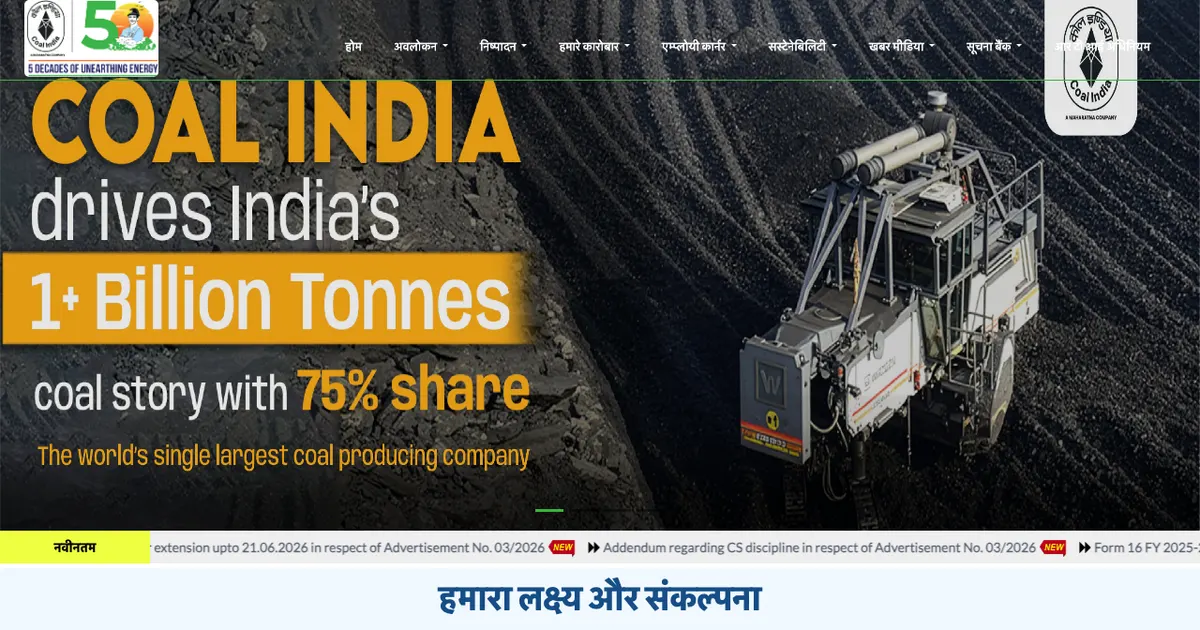
Should I add an investor relations page? Only if you are publicly listed (NMDC, Coal India, Vedanta, Hindalco, Freeport-McMoRan-tier). For privately held manufacturers and mineral processing operators in the US and India, drop IR. Replace with Capabilities, Projects and Careers.
What about multi-language for India? English plus Hindi on the homepage level is enough for most mining B2B buyers in India. Regional language on long-form content is rarely needed. Buyer decisions happen in English between buyer and seller teams.
How do I measure success on a rebuild? Three trackers, in order: form submits on RFQ, click-to-call events on phone, qualified leads from search. Track by source (Google organic, AI referral, direct). Set a ninety-day target. Recalibrate at ninety days.
About Plact
Plact builds B2B websites for manufacturers and industrial service companies, including mining and mineral processing operators shipping into India and the United States. We work in fixed scope, fixed timeline and a fixed price so the rebuild does not drift. Every Plact site ships with RFQ plumbing, full Schema.org JSON-LD, llms.txt, and copy written for buyers, not committees.
Send your current site URL and the two or three cities you sell into. We will reply within two working days with a rebuild plan, page list, and a fixed price. No sales call needed to start.
Sources
- [FAQ Optimization for B2B: Complete B2B AEO Guide [2026]](
- Meet llms.txt, a proposed standard for AI website content crawling
- What Is LLMs.txt? Guide for AI Crawlers - Similar AI
- What Is LLMs.txt & Should You Use It?
- What is llms.txt? Why it's important and how to create it for ...
- Manufacturing RFQ Complete Guide: Process & Best Practices ...
- RFQ Best Practices for Industrial Procurement: How to Get ...
- RFQ Best Practices: How to Get Better Quotes from Manufacturers
- RFQ Best Practices | CustomPartNet Library
- RFQ Management Best Practices | Manufacturing Resources
- The Best Mining Website Design Examples of 2025 - Deploi deploi.ca
- Best Mining Websites | Free Examples & Designs - Webflow
Send us your current URL and the cities you target. We reply within one business day with a page-by-page rebuild plan and a fixed price. No sales call required.
Related guides