Decision
Website Design for Construction Contractors
Plact Research
7 min read · Updated Jul 4, 2026 · Benchmarked from real competitor analysis
Key Takeaway
To secure a procurement decision, your site architecture must separate project verticals and prominently display regional credentials like OSHA compliance or RERA registrations.
A contractor website serves as a pre-qualification tool that guides a buyer's decision. Discover how to structure your site architecture to immediately prove capability, capacity, and locality to clients in the US and India.
See how your site scores against this benchmark
Free audit →What the site needs
A contractor website is not a digital brochure. It is a pre-qualification tool. Project owners in the US and India want to see three things immediately: capability, capacity, and locality. Your site architecture must reflect these priorities.
Capability is proven through structured project portfolios. You need a taxonomy that categorizes projects by sector (Commercial, Residential, Industrial, Civil) and by scope (New Builds, Renovations, Fit-outs, Infrastructure). When a logistics company looks for a warehouse builder, they must find a dedicated page showcasing your past warehouse projects within two clicks. A single "Projects" page with a disorganized grid of mixed building types fails to convert. You must separate your verticals. A civil engineering client does not want to sift through luxury home renovations to find your highway overpass experience.
Capacity is demonstrated by team size, equipment fleet, and safety records. US clients look for OSHA compliance, bonding capacity, and your EMR (Experience Modification Rate). Indian clients look for ISO certifications, machinery lists, and registrations with local authorities like RERA or MSME. Your "About Us" page must host these credentials prominently. Do not bury them in a downloadable PDF. List your owned machinery (cranes, excavators, batching plants) directly on the page. This proves you have the physical resources to execute the project without relying entirely on rentals.
Locality is critical because construction is a regional business. Your site must clearly state the cities and regions you serve. A generic "Contact Us" page does not work for SEO or user experience. You need dedicated service area pages that mention specific districts, counties, or states. If you operate in Maharashtra, create pages for "Commercial Construction in Mumbai" and "Industrial Construction in Pune." In the US, target specific counties or metropolitan areas. Procurement officers search for local contractors who understand local building codes and labor markets.
The site architecture must follow a flat, logical structure:
- Home
- Services (with child pages for specific trades like Excavation, Concrete, Structural Steel)
- Projects (filterable by sector and location)
- About Us (team, equipment, safety, certifications)
- Service Areas
- Contact / RFQ
Components that convert
B2B buyer behavior in construction dictates specific UI components. Based on B2B norms, certain elements are standard across regions, while others vary significantly. Understanding these norms is critical for conversion rate optimization.
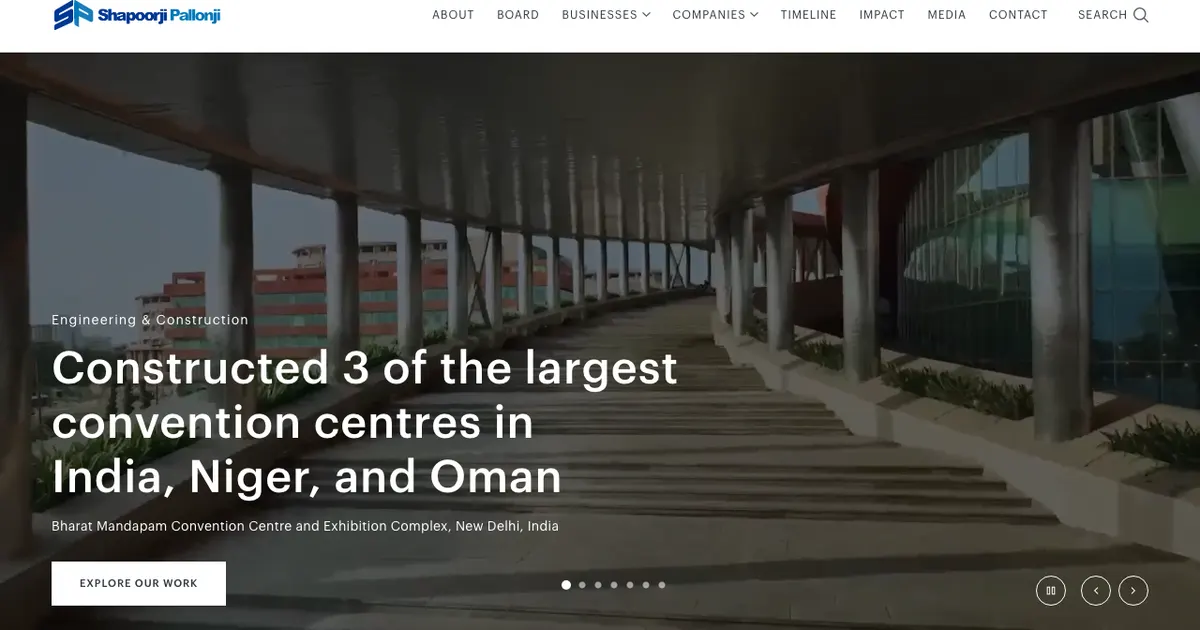
Carousels are ubiquitous. Data shows 80 to 100 percent of B2B contractor sites use image carousels on the homepage to showcase recent projects. This is not a design fad. It allows contractors to display multiple large-scale projects above the fold without overwhelming the user with text. The carousel must auto-rotate slowly but allow manual navigation. Each slide should feature a high-quality image, the project name, the project value (if permissible), and a direct link to the specific project case study. Avoid using carousels for text-heavy content like company history or mission statements. Use them strictly for visual proof of work.
WhatsApp integration is common in India, with 60 to 100 percent of B2B sites utilizing it for instant communication. Indian project managers and procurement officers prefer WhatsApp for quick inquiries and sharing site photos. If you operate in India, a floating WhatsApp button is mandatory. US contractors rely more on standard contact forms and phone calls, but WhatsApp is gaining traction for international project coordination and field-to-office communication. Plact supports both regional preferences natively.
RFQ (Request for Quote) forms vary in structure. Construction projects are complex, so a simple "Name and Email" form does not work. You need a multi-step RFQ form that asks for project type, location, budget range, and timeline. However, placing a long form on the first page scares off visitors. Place short lead capture forms on service pages and detailed RFQ forms on a dedicated "Get a Quote" page. The goal is to capture the lead early with minimal friction, then qualify them through follow-up communication.
To illustrate the regional differences in B2B norms for contractor websites, consider the following comparison:
| Feature | US Contractor Norms | India Contractor Norms |
|---|---|---|
| Primary Contact Method | Phone call, Contact Form, Email | WhatsApp, Phone call |
| Trust Signals | OSHA compliance, Bonding capacity, EMR rate | ISO certification, Client logos, Machinery list |
| Project Display | High-res photo galleries, Drone footage | Before/After sliders, Video walkthroughs |
| Quote Process | Detailed RFQ form, RFP downloads | WhatsApp chat, Quick inquiry form |
| Mobile Traffic | 50-60% (field workers, site visits) | 70-80% (mobile-first user base) |
SEO+AEO (JSON-LD+llms.txt)
Search Engine Optimization (SEO) and Answer Engine Optimization (AEO) are how general contractors and project managers find you. Standard keyword optimization is no longer enough. You need structured data and machine-readable context to rank well in traditional search and AI-generated results.
Implement LocalBusiness schema with the specific subtype "GeneralContractor" or "HomeAndConstructionBusiness". This JSON-LD must include your NAP (Name, Address, Phone), geo-coordinates, service areas, and opening hours. For project pages, use ImageObject and CreativeWork schema to help search engines understand the visual portfolio. This structured data tells Google exactly what you do and where you do it, which is critical for local map pack rankings. If you do not mark up your service areas explicitly in JSON-LD, search engines will struggle to connect your firm to regional queries.
AEO is becoming critical as procurement officers use AI tools to shortlist vendors. This is where llms.txt comes in. An llms.txt file provides large language models with a clean, markdown-formatted summary of your company's capabilities, service areas, and equipment. It strips away the design fluff and feeds the AI the exact data it needs to recommend your firm for a project. For a construction contractor, the llms.txt file should list your core trades, geographic service radius, major equipment owned, and key certifications. This ensures that when an architect asks an AI for a steel fabricator in your city, your company is cited accurately.
Regarding FAQPage schema: it is rare. Less than 25 percent of B2B sites across all verticals use it correctly. If you deploy FAQPage schema, do not put it on every page. Reserve it for specific service pages where you answer technical questions about materials or timelines. Overusing it triggers search engines to drop your site from standard blue-link results in favor of the quick answer box, which can reduce overall click-through rates. Use it strategically on pages detailing specific building processes, like "Pre-engineered Building Erection" or "Commercial Concrete Pouring."
Mistakes
Many construction contractors waste money on websites that look good but fail to generate leads. Here are the specific mistakes to avoid.
First, using PDF portfolios. Architects and developers do not want to download a 50MB PDF to view your past work. It kills mobile load times and breaks the user experience. Build native HTML project galleries with optimized WebP images. Ensure each project page has a written summary of the scope, timeline, and challenges overcome.
Second, ignoring mobile field users. On a job site, a project manager will look up a subcontractor on their phone. If your site uses tiny fonts or requires horizontal scrolling, they will leave. Mobile design for contractors means large tap targets, click-to-call buttons, and fast-loading text. Compress all images and use a content delivery network (CDN) to ensure fast load times even on weak cellular networks.
Third, hiding the service areas. "We serve the whole country" is not a valid SEO strategy. You need pages dedicated to "Commercial Construction in [City]" or "Industrial Fit-outs in [State]". Without these localized pages, search engines will not rank you for regional queries.
Fourth, missing safety and compliance data. In the US, omitting your EMR or bonding capacity is a red flag. In India, missing ISO certifications or environmental compliance documents will get you disqualified from government tenders. Make these visible on the About Us page.
Fifth, relying on stock photos. Construction is a tangible business. If your website shows generic stock images of men in hard hats looking at blueprints, you look like every other contractor. Use actual photos of your crew, your equipment, and your job sites. Even a slightly imperfect real photo builds more trust than a polished stock image.
FAQ
How often should I update my construction website? Update your project portfolio quarterly. Search engines and potential clients look for recent activity. A site showing projects from three years ago appears inactive or out of business. Add new case studies, update your equipment list, and refresh your safety statistics regularly.
Do I need a blog for my contractor website? A blog is optional. A "Resources" or "Insights" section is better. Publish case studies on how you solved specific engineering challenges or reduced project timelines. This proves expertise better than generic blog posts about construction trends. Procurement officers want to see how you handle problems, not read industry news.
Should I use FAQ schema on my contractor site? Use it sparingly. FAQPage schema appears on less than 25 percent of B2B sites. Apply it only to specific technical pages where you answer questions about building codes or material specs. Do not use it on the homepage or contact page.
What is the best way to display project images? Use lazy-loaded WebP images in a responsive grid. Implement a lightbox feature for full-screen viewing. Avoid heavy JavaScript sliders that delay page rendering. Ensure each image has descriptive alt text for SEO purposes, such as "Industrial warehouse construction in Pune."
About Plact
Plact (plact.work) is a B2B website builder designed specifically for industrial and construction verticals. We build sites that load fast, rank well in local search, and convert procurement officers into clients. We understand the technical requirements of contractor marketing, from equipment lists to safety compliance displays. Our platform handles the specific B2B norms of both the US and Indian markets, ensuring your site meets local buyer expectations.
Next Steps
Stop losing bids because of a weak website. Send us your current website URL and the list of cities you serve. We will analyze your existing digital presence and send you a complete rebuild plan
Send us your current URL and the cities you target. We reply within one business day with a page-by-page rebuild plan and a fixed price. No sales call required.
Related guides