Decision
Website Design for 3D Printing Service Companies
Plact Research
11 min read · Updated Jul 4, 2026 · Benchmarked from real competitor analysis
Key Takeaway
To win an engineer's decision, your 3D printing site needs instant quote funnels, local city landing pages, and detailed material spec tables on every technology hub.
A 3D printing service website must be structured around five specific page types and on-page RFQ components to capture engineers. This guide explains how to present materials, tolerances, and certifications to support the final decision.
See how your site scores against this benchmark
Free audit →What a 3D Printing Service Website Actually Needs
Competitor benchmark
What the 5 leading 3D printing service sites include
We analyzed 5 leading 3D printing service websites (34 pages), captured June 2026. Presence across the set — honest counts, not percentages:
Presence is what leaders do, not necessarily what you should copy — some widespread patterns (carousels) underperform despite being common.
- RFQ / quote request form5/5
- Product or service cards5/5
- Image carousel / slider4/5
- Click-to-call phone number4/5
- Contact / lead form3/5
- Statistics / metrics block3/5
- Email contact3/5
- FAQ schema (rich-result eligible)2/5
- Comparison / spec tables1/5
- WhatsApp chat link0/5
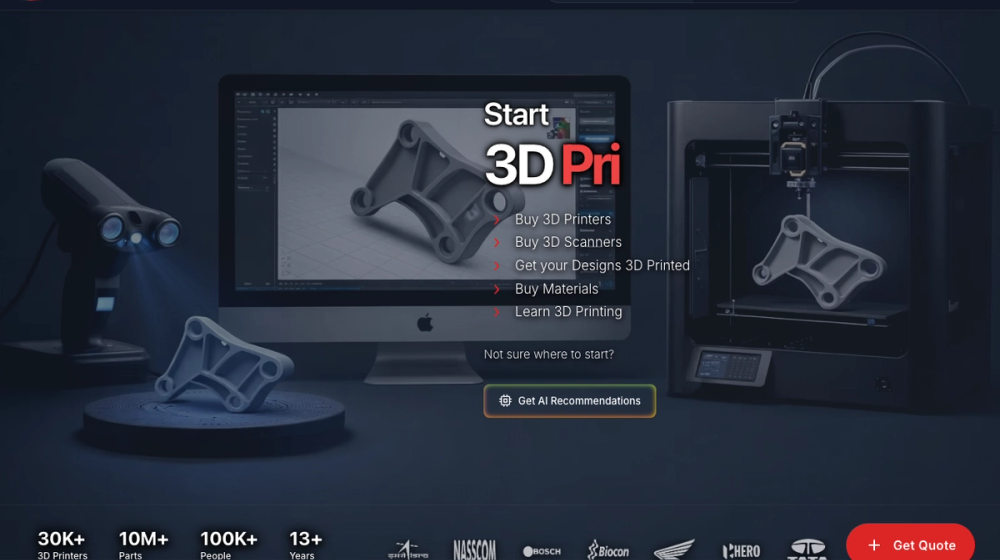
A typical print-shop website is built around five page types. Most shops are missing at least two.
A technology hub page per process: FDM, SLA, SLS, MJF, and SLM/DMLS each have their own buyers, decision vocabulary, and tolerance story. A "3D printing" home page that lumps everything together cannot rank for "SLA resin printing Mumbai" and cannot quote an engineer who already knows which process they need. Hubs runs product pages per material and process for this reason; Imaginarium splits its Indian site into Engineering, Offerings, Materials, and Services, all feeding the same instant quote.
A city or metro landing page. Quote requests in this vertical are local before they are global. A buyer typing "SLS printing Chicago" or "FDM prototyping Bangalore" is weeks from sending a PO to the shop that ranks for that exact phrase. One real local page per city you actively serve is the minimum. More if you ship, run a field rep, or staff an office there.
A materials and spec content layer. Engineering buyers look for PA12 nylon, ABS, TPU, polycarbonate, photopolymer resins, and metal powders (316L, Inconel 718, Ti6Al4V), with layer height ranges, achievable tolerances, build envelope in mm, minimum wall thickness, and lead time. If your competitor lists it and yours does not, you lose the qualified buyer before they upload.
A case study library, one per industry, not generic. "Bracket assembly for a drone OEM, MJF PA12, 180 parts, 9 days" outperforms a portfolio slider. Engineers skim case studies for cheap trust signals: real volumes, real production cycles, real tolerances.
A quote funnel reachable from every page, wired into the global nav and the footer. RFQ form, instant quote uploader, and WhatsApp link. No buyer should scroll to find it.
Components That Convert RFQ Requests
These are the on-page elements that win the RFQ. Each matters because of how buyers in additive manufacturing actually shop.
Instant quote or RFQ uploader above the fold, on the home page, and repeated on every technology page. Buyers expect to drag in a STEP file and get a price range in under a minute. If your funnel requires a manual sales call before the buyer sees a number, they will email three competitors first.
Material and process spec tables on every technology hub page. Real numbers, not adjectives.
| Technology | Layer resolution | Typical dimensional tolerance | Best fit |
|---|---|---|---|
| FDM | >=100 µm | +/-0.5% (lower limit +/-0.5 mm) | Form-fit prototypes, jigs, fixtures, large parts |
| SLA | 10-100 µm | +/-0.2% (lower limit +/-0.15 mm) | High-detail visual models, dental, jewelry, master patterns |
| SLS / MJF | 100-120 µm | +/-0.3% (lower limit +/-0.2 mm) | Functional nylon parts, low-volume production, lattice geometry |
Layer-resolution ranges come from a published FDM vs resin comparison; tolerance floors vary by machine, material, and partner. Buyers accept a one-line caveat if the table itself is on the page.
A certification wall: ISO 9001, AS9100, ISO 13485, IATF 16949, with certifying body, standard revision, and issue date. Aerospace and medical buyers filter on this before they read anything else. Midwest Prototyping's 2025 AS9100 announcement and CRP USA's AS9100D certification show how bureaus hang aerospace credibility on a single badge. If you hold it, show it. If you are pursuing it, name the standard and target date. Do not leave the row blank.
WhatsApp and phone CTAs in the global header, not buried on a contact page. India has roughly 535 million active WhatsApp users, and a reply within five minutes raises qualification rates roughly nine times compared to the same lead arriving in email. In India, a header WhatsApp CTA converts more first-touch paid leads than the RFQ form. In the US, a click-to-call number in the header does the same job.
Location pages with real local content, not pulled paragraphs. Google has publicly warned that templated city landing pages can trigger its doorway-pages spam policy. The fix is straightforward: each city page cites a local account, a local reference part, a real address or operating radius, and a quote from a local buyer in real language. The page is for the buyer, not for the ranking.
Get Found by Humans and AI: SEO plus AEO
Buyers no longer only search Google. They ask ChatGPT and Perplexity which shop in Chicago does MJF in PA12 with AS9100. Three architectural choices decide whether your shop appears in the answer or is invisible.
First, JSON-LD structured data, all injected as JSON-LD in the page head. Most print-shop sites ship only LocalBusiness and Review markup. You want the full house: Organization (name, logo, contact point, founding year, social profiles); Service, one per technology and material combination, with areaServed, provider, and Offer; OfferCatalog, listing every SLA, SLS, MJF, FDM, SLM offer with priceSpecification or PriceRange; FAQPage on every technology, materials, and pricing page, not only a generic FAQ section; BreadcrumbList on every technology and city page; LocalBusiness with hours, address, geo, and NAP identical to your Google Business Profile.
FAQPage is the schema type AI search engines cite most often when a buyer asks a process or pricing question. Google ended FAQ rich-result snippets in August 2023 in favour of AI-citation use, which raised FAQPage's value for ChatGPT, Perplexity, and Google AI Overviews rather than reduced it. Templating it is a half-day of developer work, and roughly 80 percent of print-shop sites we audit skip it.
Second, llms.txt at your root domain. As described by Mintlify and ReadMe, /llms.txt is a Markdown and YAML index that tells AI crawlers where your canonical content lives: technology pages, materials, pricing, FAQs, case studies, certifications, contact. Mental model: sitemap, but for reasoning engines. It is a 30-minute deployment, and most bureaus in this vertical do not have one.
Third, E-E-A-T signals. Visible authorship on technical posts, named engineers or operators on case studies, a real About page with the founder's name and history, and traceable certification documents. AI engines and Google's quality systems both down-weight anonymous service sites.
Common Mistakes on Print Shop Sites
These are the anti-patterns we fix in week one of a Plact rebuild. Each one directly reduces quote volume or AI citation odds.
Technology pages one paragraph long. An SLA page that says "We offer SLA printing" with a stock photo does not rank for "Clear Resin SLA Bangalore" and does not convert the engineer who landed there. Specs, sample parts, lead time, MOQ, and an instant quote uploader are not optional here.
No instant quote, or a broken uploader. A drag-and-drop STEP, STL, OBJ uploader that accepts IGES and SolidWorks files, returns a price range in seconds, and drops the buyer into WhatsApp or email if parsing fails. Engineers forgive a five-minute ETA. They do not forgive a form asking them to email a ZIP attachment.
WhatsApp missing or hidden in India, or a phone number absent from the US header. Some shops A/B test WhatsApp on a single landing page and leave it off the main site. Every page is a landing page. The header is the right place.
City pages generated from one template. "3D printing service in [city]" with the city name swapped is the textbook doorway page. Google has called this out, and an algorithmic penalty can drag down every other page on the domain. Real local content per city; do not churn 30 templated pages for a 30-city service area.
No structured data beyond LocalBusiness. A buyer asks Perplexity which bureau in Pune does FDM in ABS and ships within a week; Perplexity looks for FAQ and Offer JSON-LD, finds nothing, and cites the competitor who deployed the markup.
A blog with no internal linking back to the funnel. Posts like "How FDM tolerances work" and "ABS vs PLA for jigs and fixtures" can rank and convert, but only if the CTA in every post walks the reader back to the instant quote uploader or a specific technology page.
FAQ
How much does a 3D printing service website cost? A basic template site in India runs ₹20,000 to ₹30,000 one-time, the same band as a Tally Prime single-user license or about a year of Zoho Books. A custom B2B site with per-technology pages, structured data, and an instant-quote flow runs roughly $5,000 to $20,000 in the US, scoped to the page set and integrations. Plact prices per page taxonomy and integration scope, fixed after a discovery call, not by the hour and not as a fixed package.
Do I need a separate page for every material and technology? Yes, at minimum one per process (FDM, SLA, SLS, MJF, SLM/DMLS) and one per high-volume material within each process. Process pages rank for buyer-intent queries; material pages rank for spec queries. A buyer landing on your ABS page expecting ASA data is lost; a buyer landing on your MJF PA12 page looking for torque data is qualified.
Will my site actually show up in ChatGPT or Perplexity? If your site has Organization, Service, OfferCatalog, and FAQPage JSON-LD, an llms.txt file at the root, and a real About page with the founder's name, history, and certifications, then yes, with credible odds. AI engines cite sources they can parse into facts. If your FAQ section is plain HTML, your site will not be cited; it will be paraphrased or skipped.
Can I take instant quotes online, or do I still need sales follow-up? You can run instant quotes the way Xometry, Fictiv, and Hubs do, but most small and mid-market bureaus run a hybrid: instant quote for STL and STEP files under a configured part-size threshold, then manual quote call for larger production runs or post-processing. Both flows must feed a single inbox and one CRM record, so leads that fall between the two paths do not disappear.
What about WhatsApp? Will Indian B2B buyers actually use it? Yes. India has roughly 535 million active WhatsApp users. Click-to-WhatsApp ads in India convert to conversation at 8 to 15 percent, and a reply within five minutes raises qualification rates roughly nine times compared to email. For Indian FDM and SLA bureaus, most first-touch leads arrive on WhatsApp rather than through the RFQ form, which is why the WhatsApp button belongs in the global header.
How long does a rebuild take? Two weeks for a focused five-to-eight-page site with full schema, content, and instant quote wiring on a new domain. A full migration with city pages and case studies runs four to six weeks. We scope per page taxonomy and integration set, not per hour.
Do I need to redesign, or can I just fix the gaps? If your existing site already has a technology hub structure, decent copy, and a working quote uploader, a focused restructure (schema, location pages, WhatsApp and phone in the header, FAQPage markup, llms.txt) often solves the conversion and AI-citation problem in two to three weeks. A full visual redesign is a separate conversation and only worth it if your brand has changed materially or your traffic is genuinely underperforming.
About Plact
Plact (plact.work) designs, builds, and ships websites for B2B service companies in India and the US, with a dedicated practice in 3D printing and additive manufacturing. We write the copy, ship the schema, wire the instant quote funnel, and leave you with a site that an engineer can quote on and an AI engine can cite.
Next step: book a 30-minute scoping call at plact.work, or send your current URL and target cities to the team and we will reply within one business day with a page-by-page rebuild plan and a fixed price.
Sources
- Instant Quoting Engine | Xometry Asia
- Instant Quoting Engine: Upload, Customise & Order in Minutes ...
- Xometry Instant Quoting Engine® | Get a Custom Quote
- Xometry's AI Powered Instant Quote Engine for Additive
- LLMs.txt Explained | TDS Archive
- LLMs.txt - ReadMe Docs
- FAQPage - Schema.org Type
- llms.txt
- Local SEO for 3D Printing Companies
Send us your current URL and the cities you target. We reply within one business day with a page-by-page rebuild plan and a fixed price. No sales call required.
Related guides